


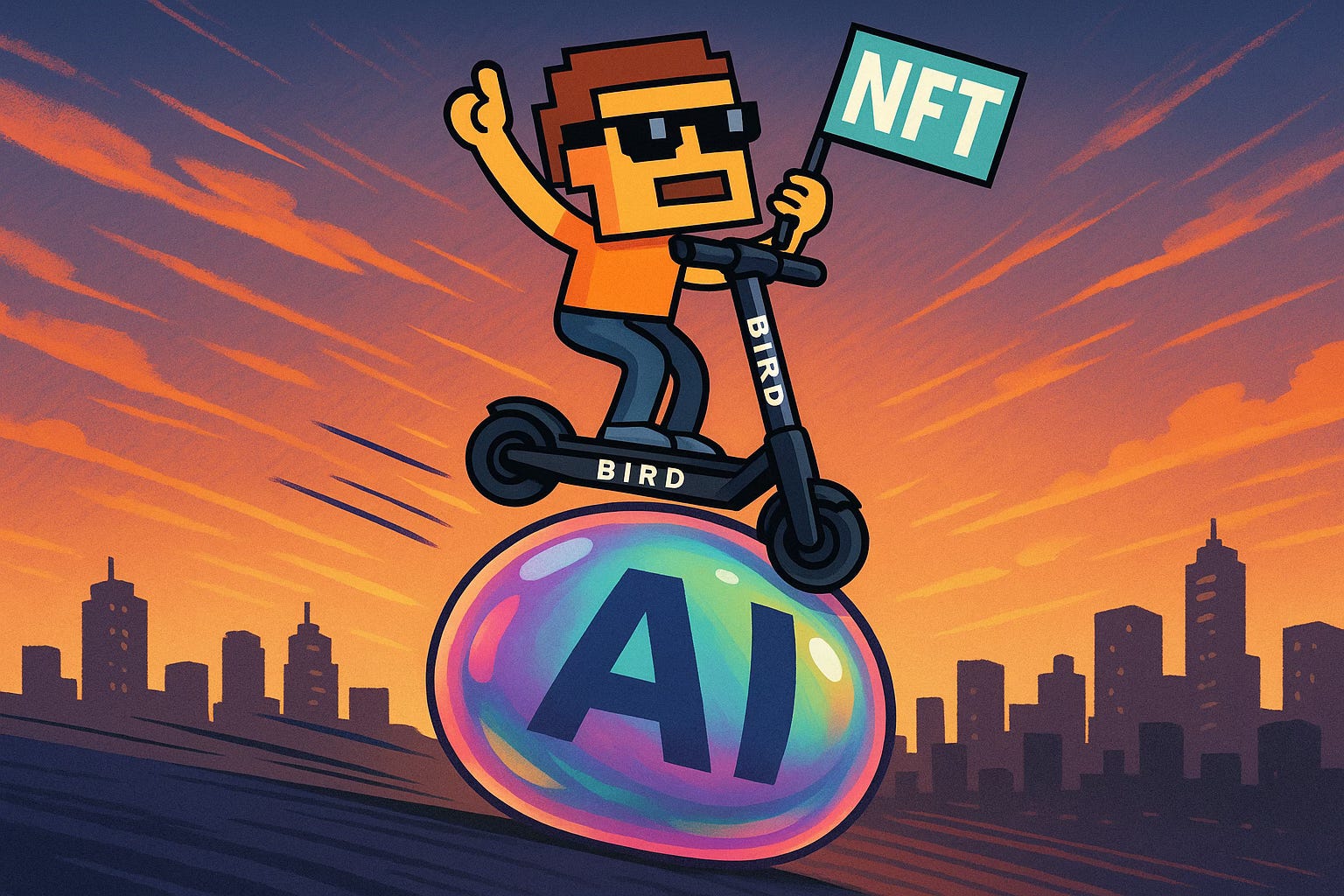
Since the 2008 housing crisis, investors and speculators have hunted for the next money-making rocket ship—like gamblers convinced that if they just find the right system, they can bet the house. And the greediest speculators have fallen into the delusion that just about any digital technology can improve or grow exponentially forever, which means "money go up" forever as well. Hint: nothing grows exponentially forever; physics, resources, wallets, and governments all have a way of bringing exponential dreams back to earth. The roster of overhyped, overinvested technologies from the past 10–15 years is too long to list, but here are a few you might remember.
The Metaverse was hyped so hard that Facebook rebranded as Meta—and has since burned $50B+ and counting on the metaverse. Apple, feeling the pressure, shipped an internal hobby project—the Apple Vision Pro—as if it were a real product. How many meetings did you have in the Metaverse last week? Or birthday parties? Exactly.

Remember when your city was littered with bike shares and scooters—so-called micromobility “platforms”? [Hint: if you’re just renting a physical product, you can juice your valuation by calling it a platform—see WeWork. “Platforms” are now just tech jargon for something consumers don’t buy but instead rent or subscribe to.] They’re now few and far between. China’s Ofo—once a $2B unicorn—unraveled amid mass refunds and city withdrawals. Bird, the scooter company that became the fastest U.S. startup to hit a $1 billion valuation in 2018, is only now emerging from bankruptcy, while hundreds of millions owed to cities will probably never be paid. Most of these firms fueled their “exponential” growth by subsidizing usage with investor money.

NFTs (non-fungible tokens) are an interesting technology (think of them as digital collectibles you can’t touch), but the market devolved into a speculative frenzy—fueled by celebrity hype and the lure of easy participation. In 2022, NFTs generated $24.7 billion in sales, yet of the 73,257 NFT collections identified by dappGambl, 69,795 have a market cap of $0. In other words, 95% of holders are stuck with worthless investments. Worse, people earning under $25k invested at roughly the same rate as those earning over $150k. I have no sympathy when asshole billionaires like Marc Andreessen lose money—in fact, I quite like it. But a whole lot of people who couldn’t afford it lost a lot of money on NFTs, which changed their family’s trajectory for the worse.
How about Hyperloop, the magnetically levitating trains in vacuum tubes that travel at airline speeds? After billions spent by multiple companies, it's turned out to be the Juicero of trains.
“Passengers may be willing to accept the risk of dying from leaks in a capsule surrounded by near vacuum. But only as long as they’re comfortable before they die. I don’t think they’ll accept having their teeth shook out along the way.” —Sabine Hossenfelder.
Or crypto exchanges and ICOs (Initial Coin Offerings)? That all blew up with Sam Bankman-Fried and FTX. Instead of pausing to ask how they were duped into believing ICOs were some magical *number-go-up* technology, investors just moved on to the next thing. (Yet the Trump family still seems to be riding this grift.)
So it’s not surprising we’re in an AI bubble—it feels like the cumulative result of years of investments in overhyped, overvalued technologies. The stock prices of the major technology companies bear little relation to daily operations; they hinge on a magical future when some useful application mints gobs of money. AI is so expansive that companies can spin a tale in which their AI does all the work—a sweeping story, and plenty of people seem to believe it. Here is some of the data behind the theory that there is an AI bubble in the financial markets:
In 2023–2024 U.S. equity markets were propelled by seven tech‑heavyweights – Apple, Microsoft, Nvidia, Alphabet, Amazon, Meta and Tesla, the so-called “Magnificent 7”. Reuters reports that these seven stocks were responsible for well over half of the S&P 500’s 58 % return during those two years. Even after a pull‑back in early 2025, the same group still accounts for about 30 % of the S&P 500’s weight (down from 34 % at the start of the year).1
This market concentration exceeds the dot‑com era; the broad technology sector now makes up 34 % of the S&P 500’s market capitalization, higher than the 33 % record set in March 2000. The combined market value of the top ten companies is nearly $22 trillion, or 40 % of the index, vs 25 % in 19992.
Apollo Global Management’s chief economist Torsten Sløk warns that AI‑driven stocks are more over‑valued than dot‑com stocks were in 1999. In a July 2025 note cited by Fortune, Sløk argued that the difference between the IT bubble and today’s AI bubble is that “the top 10 companies in the S&P 500 today are more overvalued than they were in the 1990s”. He noted that investors have bid up shares of Nvidia, Microsoft, Apple and other AI bellwethers to levels detached from their earnings.3
And this is just the big fish, many minnows are using AI-first jargon and ideas to make their company’s valuation go up—hence the massive over-investment in AI, a far more complex—and, dare I say, useful—technology than the ones above.
Unlike some of the other tech bubbles I mentioned, Machine Learning (ML) and LLMs (Large Language Models) are each genuinely useful—I think each will be as significant as the internet in reshaping society (but not necessarily for the better).
Remember: the dot-com bust didn’t kill the internet.
Likewise, we’re likely headed for a collapse in stock prices and private valuations across many AI companies, even as the technology keeps advancing. LLMs like ChatGPT will become a “normal” part of our digital lives and probably change how we work and live. How? I can only speculate.
As I wrap up this little diatribe, here are a couple of articles from people smarter than I am on what comes next for AI—regardless of when or how the AI finance bubble bursts.
What if A.I. Doesn’t Get Much Better Than This? by Cal Newport.
AI as Normal Technology. By AI Snake Oil
Let me know what you think in the comments below.
🛒 Products I Make and Sell 🚀
I can’t let my former students have all the e-commerce fun! My new Shopify store is part store, part experiment, where you can buy tools, gadgets, art, and prototypes born of my experiments with rapid prototyping, AI, 3D printing, and IoT. I launched this shop to really learn how ideas move from sketch to storefront, check it out and let me know what you think! You might even find something you must have! 🤣


🎒 Learn AI with ME
My friend Tojin T Eapen and I are about to release a series of courses about AI. These will be practical, hands-on courses, with limited cohorts and one or more meetings on zoom. If you were to sign up to take an AI course, what would you want to learn? If you can take a moment and let me know by completing this form, I’d appreciate it. And enter your name and email if you want to be notified when the first course launches and be part of our pilot!
👍 Products I Recommend
Products a card game for workshop ideation and ice breakers (affiliate link). I use this in my workshops and classes regularly. Made by a former Mizzou student Aaron H.
📆 Upcoming Talks/Classes
I will be presenting “Learn Blockchain Through Play” with Maria Rosaria Maschio this Friday, September 5 at 9am in Cornell Hall. This is part learning activity and part research. Details are below and send me an email if you want/need a parking pass. I promise you will leave understanding the principals of Blockchain!
Curious about blockchain and how it’s used in cryptocurrency and other applications like food supply chains? Join our fun and interactive workshop where you'll play The Blockchain Game and explore how this technology helps track food from farm to table. Note: This workshop is part of a research project exploring how learning about blockchain affects consumer perceptions of food traceability. Your participation will help us understand the value of education in this field and you will help to create new knowledge!
I will be presenting “AI Agents: Friend or Foe?” for the Human Resources Association of Central Missouri on September 9th at 8:30 am. Details about the program will be posted here.
Description: AI “agents” are the next step beyond chatbots: digital teammates that set goals, take actions across your apps, and finish real work while you sleep. Prof C will explain—in plain language—how these tireless helpers can streamline HR tasks like onboarding and analytics … and why the same autonomy can create new risks if we’re not careful. Join us to learn simple guardrails for deciding when an AI agent is a friend, when it might become a foe, and how to stay firmly in control.
I will be presenting “AI Strategies” for the Red River Valley Estate Planning Council, in Fargo, North Dakota on November 19. Details are available here.
https://www.reuters.com/business/autos-transportation/tarnished-magnificent-7-stocks-rebound-faces-test-with-earnings-2025-04-30/
https://www.reuters.com/markets/europe/is-todays-ai-boom-bigger-than-dotcom-bubble-2025-07-22/
https://fortune.com/2025/07/17/ai-bubble-vs-dot-com-stocks-apollo-economist-torsten-slok/
'..many minnows are using AI-first jargon and ideas to make their company’s valuation go up..." Reminds me of 1999 (to which you refer) when companies could be a bump in price by adding ".com" or "dotcom" to their name. "We use AI" has the same feel to me.