

In the Future, No Interface Will Be Standard
BYOI (Build Your Own Interface) is the future of UX

I’ve written before about “vibe coding“—building software by describing what you want to a Generative AI system in plain English. In that piece, I used a tool called Lovable to clone a scheduling website (When2Meet) in about 90 minutes, adding features the original site lacked.
But my colleague Sophia RH recently showed me something that takes this idea further—and points toward a future where standardized software interfaces become optional.
Sophia was teaching students at Mizzou how to write effective AI prompts. To demonstrate the power of these tools, she sent her students into small group discussions—and while they talked, she built an app.
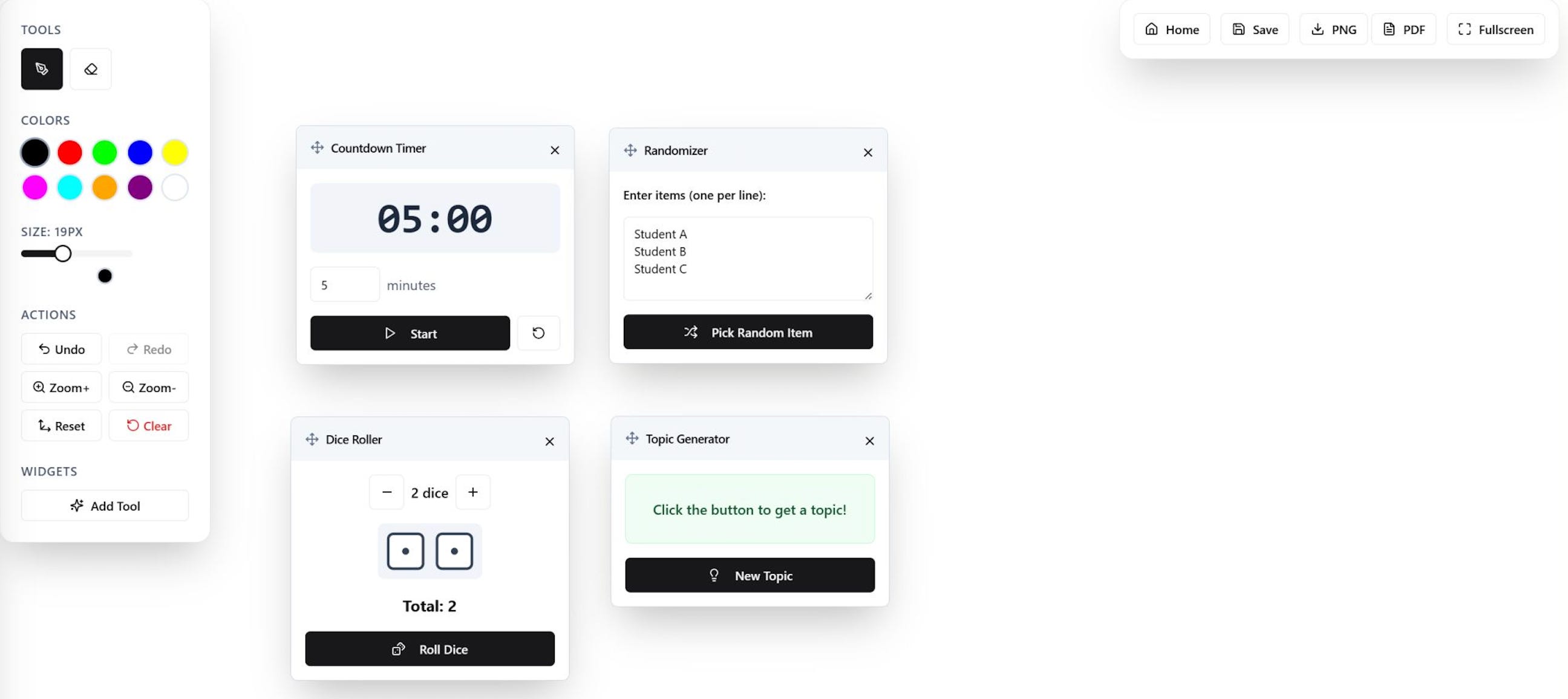
The classroom she teaches in doesn’t have a whiteboard front and center. It relies heavily on the computer and projector. So Sophia logged into Base44, a vibe-coding platform similar to Lovable, and created a whiteboard app tailored to her exact needs. With just a few prompts, she reduced the pen latency to more closely mimic physically drawing, added widgets for timers and a randomizer, included a topic generator and other features she thought would be helpful, built in infinite scroll, and added a download/save feature.
All of that in a few minutes. When her students came back from their discussions, she pulled up the app and took notes. The next time they went off for discussion, she had the timer ready.
Building for Yourself
What struck me about Sophia’s example isn’t that she built an app quickly. What’s interesting is that she built exactly the interface she needed for her specific classroom, her specific teaching style, and her specific constraints at that moment.
No existing whiteboard app does precisely what Sophia wanted. Some come close. But they all require you to adapt your workflow to their design choices. Sophia flipped that equation: she adapted the software to her workflow.
This is a small example, but it illustrates something bigger. For decades, we’ve learned to work within the interfaces that software companies give us. We memorize where settings are buried (and when the location of those settings change we are lost). We develop workarounds for features that almost—but don’t quite—do what we need. We accept that the software serves millions of users, so it can’t be tailored to any one of us.
Vibe coding changes that calculus. When building a custom interface takes minutes instead of months, the economics shift. The effort required to adapt to imperfect software can exceed the effort to build something better.
The Platform Problem
This creates interesting implications for software companies that have built their businesses around controlling the user interface.
Platforms profit by deciding what you see and how you see it. They surface the features that drive their metrics. They bury the options that don’t serve their goals. They can change everything overnight while you adapt yet again.
But if users can simply build their own interfaces—or, increasingly, deploy AI agents that interact with software on their behalf and report back only the information they actually want—platforms lose that control.
Tools like Browser-Use and OpenAI’s Operator let AI agents navigate websites just like humans do, clicking buttons and reading screens. Your agent doesn’t see the promoted listings. It doesn’t get distracted by the dark patterns. It just accomplishes your task and moves on.
Jakob Nielsen, the “godfather of usability,” recently argued that we’re approaching a future where users only interact with their AI agents, and the agents handle all the actual clicking and scrolling. The traditional user interface, in this view, may simply vanish for many applications.
Room for Shared and Individual Interfaces
I don’t think standardized interfaces will disappear entirely. For complex, collaborative work, shared interfaces create shared understanding. And many people will continue to prefer polished, professionally designed applications over whatever they could build themselves.
But for individual workflows—the specific ways each of us actually gets work done—the era of adapting ourselves to software may be ending. Sophia didn’t need to learn a whiteboard app’s quirks or wait for a feature request to be prioritized. She described what she wanted and got it.
As these tools improve, more people will discover that the interface they’ve been tolerating isn’t the interface they have to accept.
What software do you use that doesn’t quite work the way you think it should? I’m curious what you’d build if you could. And even more curious to learn if you have already experimented with creating your own interfaces.
My commentary may be republished online or in print under Creative Commons license CC BY-NC-ND 4.0. I ask that you edit only for style or to shorten, provide proper attribution and link to my contact information.
I use GenAI to help me edit this newsletter. For details, and the exact prompts I use, see this post.
Book Me for Your Next Conference or Event
After nearly two decades teaching and building innovative programs at the University of Missouri, I’m now focusing more of my time on keynote speaking and workshops—helping organizations make sense of the emerging technologies reshaping work, learning, and leadership.
If your organization, conference, or leadership team is exploring how to navigate AI and emerging technologies responsibly—and productively—I’d love to talk.
For more details, topics, and booking information click here.
📥Recent Talks, News and Updates
I gave several talks recently (Chamber of Commerce, Red River Estate Planning Council, Association of Government Accountants, etc.), and I have compiled a master list of all the studies and articles that I cited or used in these talks, organized by topic. Check it out here: www.profc.io/ai-links
I presented a “Lunch and Learn” at the Daniel Boone Library in collaboration with the League of Women Voters on “AI and Democracy — Guardrails We Can Choose” on December 10th at Noon. You can view the video below.
👍 Products I Recommend
Products a card game for workshop ideation and ice breakers (affiliate link). I use this in my workshops and classes regularly. Made by a former Mizzou student Aaron H.
📆 Upcoming Talks/Classes
I am teaching a short course “Thinking Machines, Changing Minds: How AI Is Shaping Work and Wisdom” for Osher about AI during the Winter 2026 semester. Details and registration are available here.
I will be presenting “AI Externalities” at Law, Technology, and Society: Charting the Next Frontier symposium on the MU campus on April 15th. Details coming soon.
If these tools can produce secure work that works within privacy standards, this may be one of the most compelling use cases I've seen for AI. That will be the biggest problem they have to overcome. It would be problematic to enter any PII into them at this point because of FERPA, HIPAA, and other laws. (For readers outside the US, these are,the main privacy laws regulating student and health data.) That said, this sounds incredibly promising.